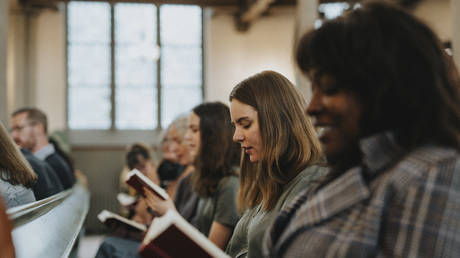
Gen Z and Millennials are driving an unexpected return to the pews, reversing decades of decline in faith and worship attendance
Growing up in southwestern Pennsylvania in the 1970s, it seemed like everyone I knew attended church services every Sunday without fail. Then something unexpected began to happen. The Catholic school I attended – like others around the country – was forced to merge with other schools to keep classrooms filled. At the same time, many churches of all denominations began closing their doors only to reopen as shopping malls, restaurants, or boutique hotels.
In total, over the past several decades, median worship attendance in the US plummeted by more than half. And the reason cannot be blamed on demographics. The US population has consistently increased for over a century, growing from roughly 76 million in 1900 to over 343 million by 2025, reinforced by heavy rates of immigration, both legal and illegal. Yet 40 million Americans have stopped attending church in the past 25 years, which works out to about 12% of the population.
Some people have pointed to mental health problems in American society as the culprit.
“The problem in front of us is not that we have a healthy, sustainable society that doesn’t have room for church,”writes Jake Meador in The Atlantic. “The problem is that many Americans have adopted a way of life that has left us lonely, anxious, and uncertain of how to live in community with other people.”
The downturn in church membership was at least partially due to alarming problems within the church as lurid scandals involving sexual abuse charges among the clergy and young boys grabbed the headlines. But now it seems that worshippers are willing to forgive the church for past offenses and are making a gradual return to the pews.
A new report from the Hartford Institute for Religion Research shows signs of a shift – for the first time in two decades, church attendance is up. “Across a range of indicators, there are signs of recovery and, in some cases, renewal,” the study’s authors wrote in a report released on April 24, which surveyed a representative sample of leaders at 7,453 congregations between September and December of 2025.
Median in-person attendance, which dropped from 137 per service in 2000 to 45 during the Covid pandemic, is now at 70 adults. That is higher than the 2020 Faith Communities Today survey from the Hartford Center for Religious Research, which put the figure at 65.
Surprisingly, it is young people who are leading the charge back to the houses of worship. For decades, older adults – Boomers and older – were the most frequent churchgoers. Today, the pattern has been turned on its head.
According to 2025 Barna Group data, Gen Z (18-28) and Millennials (29-44), who once had a notorious reputation for their disinterest in church services, are leading a historic resurgence in church attendance, now attending more frequently than older generations. Gen Z averages 1.9 weekend visits monthly, while Millennials average 1.8, reversing a decades-long trend. Among Gen X – those born between 1965 and 1980 – churchgoing has landed at about the same rate as it was in 2000. This shift indicates a strong, renewed interest in faith, community, and purpose, with some reports noting young men are key drivers of this growth.
“The significant drop-off among older generations shows that the fabric of congregational life is changing. It’s more frayed and less gray than it was a decade ago,” notes David Kinnaman, CEO of Barna Group. “The influx of new generations represents a massive opportunity for congregational leaders, but this renewed interest must be stewarded well.”
“Our research clearly shows that churchgoing alone does not in itself create devoted disciples. Even with the increasing participation of younger generations, there is still the challenge of shaping hearts and minds to live out their faith beyond church participation,” adds Kinnaman.
So what is responsible for getting people, predominantly the young, back in the pews? Part of the growth is explained by churches – particularly nondenominational ones – understanding that it was important to make attendance an interesting and vibrant event for youth to get them through the doors. The empty recital of prayers was no longer working. This has led to the modernization of church services, which now includes social events, musical concerts by popular religious bands, and other such ‘gimmicks’. The introduction of the so-called nondenominational ‘megachurches’, which allows for more publicity, has also played a part in the rise among the youth.
Moreover, young people may be feeling empty inside from their endless addiction to their smartphones and social media. A return to religion and spirituality might just be what they need to fill the void.