The ongoing US-Israeli war on Iran could render large parts of the region uninhabitable
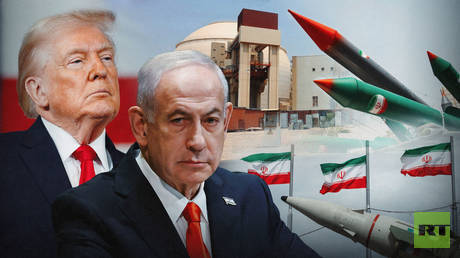
A war launched by the US and Israel with the stated aim of preventing a nuclear crisis could end up causing one.
With repeated strikes reported near the Russian-built Bushehr Nuclear Power Plant in Iran, discussions about the US potentially forcibly taking Iranian uranium reserves, and seemingly zero room for compromise, the likelihood of radioactive fallout across the Middle East is steadily increasing.
Strikes getting closer to Bushehr reactor
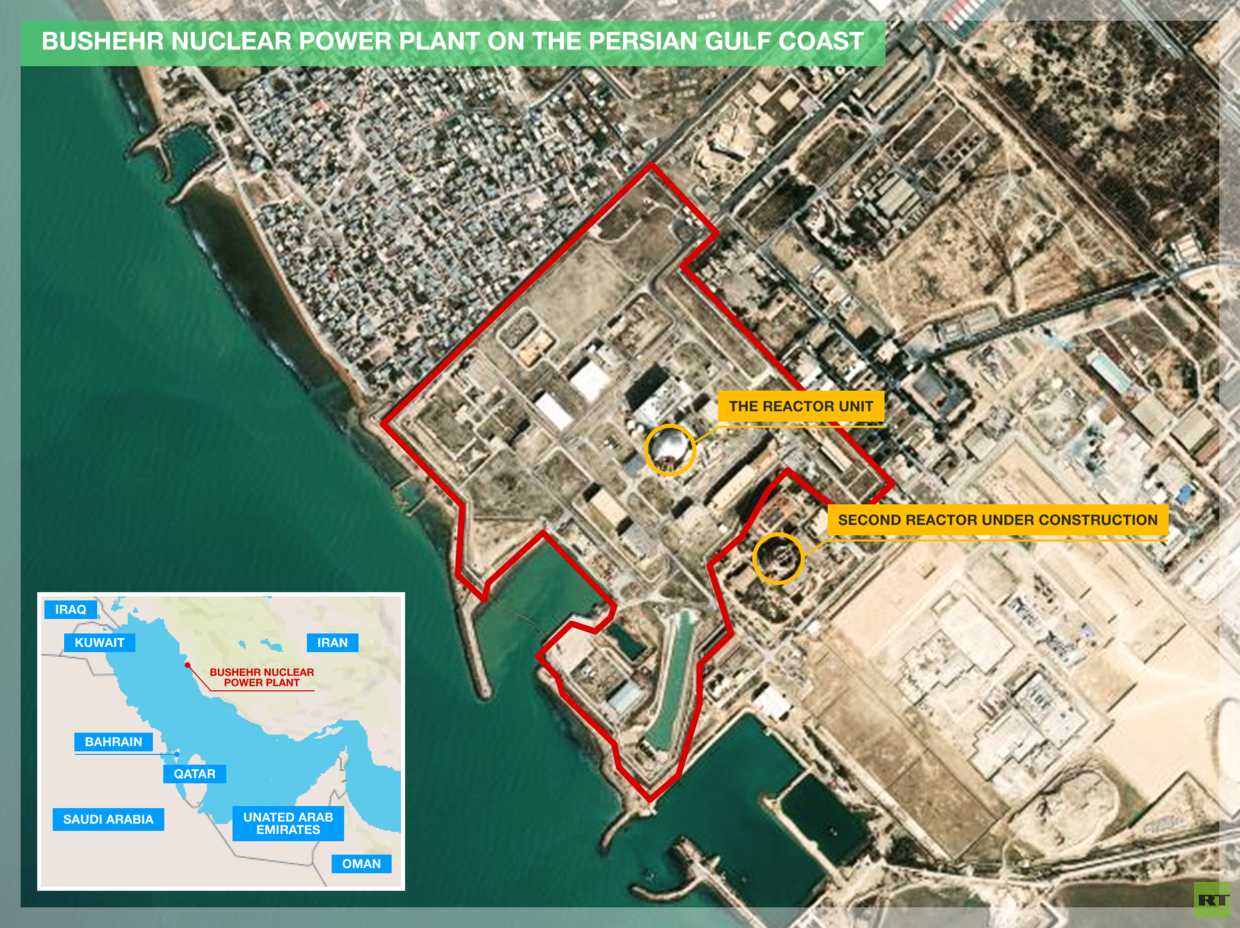
Since the US-Israeli war on Iran began on February 28, Tehran has reported four separate military strikes near its Bushehr Nuclear Power Plant on the Persian Gulf coast. The facility’s roughly-square territory spans some 500 meters across, with a single reactor unit located at its center.
In the most recent incident on April 4, one of the projectiles landed just 75 metres from the site’s perimeter, the International Atomic Energy Agency (IAEA) reported, citing satellite imagery analysis. In mid-March, the UN nuclear watchdog reported that an attack had destroyed a structure around 350 metres from the reactor.
Risking damage to Bushehr site ‘suicidal’
The plant was constructed by Russian specialists and still hosts a Russian team, although operator Rosatom has reduced staffing to a skeleton crew since hostilities began. The company stated that the March 17 strike marked the first time a weapon landed within the facility’s protected zone, hitting near a meteorological building.
On the first day of the conflict, Rosatom chief Aleksey Likhachev warned that an operational nuclear power plant “is not a practice target,” stressing that military activity near such installations is “unacceptable and suicidal.”
Russia’s Foreign Ministry also condemned the incidents near Bushehr, warning on April 6 that “the shadow of a radiological disaster more severe than Chernobyl now looms over the Persian Gulf” and surrounding areas.
Worst case scenario for Bushehr
Modern nuclear power plants are designed with multiple layers of protection to prevent the release of radioactive material. However, disasters such as Chernobyl in 1986 – caused by a catastrophic reactor failure during a botch experiment – and Fukushima in 2011 – triggered by a natural disaster – demonstrate that severe accidents remain possible and warrant abundance of caution.
The recent incidents near Bushehr serve as “a stark reminder: a strike could trigger a nuclear accident, with health impacts that would devastate generations,” World Health Organization head Tedros Ghebreyesus cautioned, echoing calls from the IAEA for deescalation.
I join the @iaeaorg in raising the alarm again over the safety of nuclear facilities in #Iran.
The latest incident involving the Bushehr nuclear power plant is a stark reminder: a strike could trigger a nuclear accident, with health impacts that would devastate generations.… https://t.co/mvFRC23EpT— Tedros Adhanom Ghebreyesus (@DrTedros) April 5, 2026
A worst-case scenario involving a large-scale release of radioactive material from Bushehr could render not only parts of Iran but also neighboring states such as Qatar, Kuwait, and the UAE uninhabitable, even without direct fallout, according to Peter Kuznick, director of the Nuclear Studies Institute at American University.
“If Cesium-137 contaminates water supplies, it becomes extremely difficult to remove,” he explained to RT. Some regional countries get 100% of their drinking water from desalination systems that would likely be compromised, should Bushehr be seriously damaged. “This war is so reckless and out of control at this point that anything is possible,” he said.
As in Ukraine, so in Iran
Iranian Foreign Minister Abbas Araghchi has criticized what he described as a lack of Western condemnation over threats to Bushehr, compared to accusations of Russia related to the Zaporozhye Nuclear Power Plant.
The formerly Ukrainian facility, under Russian control since 2022, has faced repeated attacks or nearby incidents as Kiev continues to pursue its recapture. The IAEA maintains a monitoring mission at the site but does not assign blame for strikes, citing limitations of its mandate – a policy it also follows in Iran. Supporters of Kiev lay the blame squarely on Moscow.
Threats beyond Bushehr
The stated justification for the US-Israeli campaign is that Iran was allegedly close to acquiring nuclear weapons – despite the damage the two nations inflicted on its nuclear infrastructure last year.
The administration of US President Donald Trump argues that Iran has no right to a civilian nuclear program, a position that conflicts with the Nuclear Non-Proliferation Treaty (NPT).
Tehran has long denied any intention to develop nuclear weapons, citing religious prohibitions against weapons of mass destruction. However, the targeted assassination of Supreme Leader Ali Khamenei in the opening shot of the war may have shifted political calculations in Iran.
Ahmad Naderi, an influential MP, has urged Iran to follow North Korea’s example, arguing that “if we were also armed with nuclear weapons, Trump would not dare to threaten bombing.” The NPT’s core deal is that a signatory gets IAEA help in building up the nuclear industry in exchange for oversight preventing weaponization.
The US and Israel have ignored the international agency’s mandate to strike Iran’s Natanz enrichment site attacked on March 21. Meanwhile, attacks on industrial facilities have raised additional concerns. The Khuzestan Steel Production Factory, attacked in late March, uses radioactive isotopes for gauging, the IAEA warned, noting that no breach of sealed sources was detected.
Hunt for the uranium stockpile
The greatest contamination risk may stem from Iran’s stockpile of highly enriched uranium, believed to be stored in underground facilities in Isfahan and Natanz following the US-Israeli attacks last summer.
The IAEA estimated in June 2025 that Iran possessed over 440 kg of uranium hexafluoride enriched to 60%, while some assessments suggest the stockpile could be larger by as much as 100kg.
There has been speculation that a large-scale US military operation – officially described as a rescue mission for aircrew of an F-15E jet downed in Iran on April 3 – may have been linked to efforts to locate and secure the uranium. The mission involved around 150 aircraft, including transport planes that were stuck on the ground and destroyed to avoid capture, according to American officials.
Emerging evidence suggests that U.S. operations south of Isfahan (marked in red on the map) were unrelated to any pilot rescue mission.
Israel, widely believed to possess a nuclear arsenal, faces similar vulnerabilities. Following the attack on Natanz on March 21, Iran retaliated with strikes near Dimona and Arad, two towns close to the heavily fortified Shimon Peres Negev Nuclear Research Center.
“Our air defense system is among the best in the world, but it is not hermetic,” a senior Israeli air defense commander commented. “There are errors and malfunctions.”
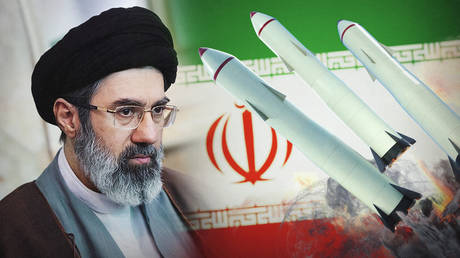
The implied threat to the facility was later reinforced in an Iranian AI propaganda video depicting the country’s new leader considering a direct attack on the Iranian nuclear reactor.
First appearance of the new Iranian supreme leader Mojtaba Khamenei in an AI-generated video. The main message: the Nuclear Research Center in Dimona. pic.twitter.com/sXXtAwk6Uc— Baxtiyar Goran ☀️ (@BaxtiyarGoran) April 5, 2026
Running up the escalation ladder
Although already highly destructive, the conflict still has significant room for escalation, including the potential use of nuclear weapons.
The US used the option in 1945 against Japan, a nation that refused to admit defeat at a moment when a Soviet ground attack was becoming increasingly possible. Mutually Assured Destruction (MAD) made the use of nukes a taboo during the Cold War.
Israeli officials and pro-war aid reportedly swayed Trump aides with a promise that his political legacy would be secured if he were to do what no president had done before him and launch a regime-change war against Tehran. “Trump has broken every custom, every norm, every tradition, every international law, most US laws,” Kuznick noted “The same psychology applies to the nuclear taboo.”
Likewise, Israel came close to using nuclear weapons during the 1973 Yom Kippur War but ultimately then-Prime Minister Golda Meir refrained after battlefield conditions shifted against Egyptian and Syrian forces.
What decisions Trump or Benjamin Netanyahu might take, should the latter’s 40-year dream of crushing Iran slip away, is becoming an increasingly concerning question.