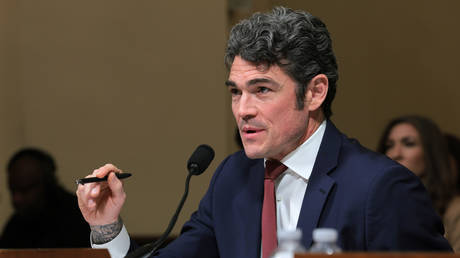
The German chancellor said 80% of Syrians could return home within three years, attributing the figure to Ahmed al-Sharaa
Syrian leader Ahmed al-Sharaa has denied claims that he told German Chancellor Friedrich Merz that up to 80% of Syrians living in Germany could be convinced to return home within three years.
Merz cited the figure and timeline on Monday during a joint press conference with al-Sharaa, a former jihadist commander who seized power in 2024 after overthrowing the previous government. Following criticism, including from within his own political camp, Merz claimed on Tuesday that the estimate had originated from al-Sharaa.
Speaking later that day at an event hosted by the London-based think tank Chatham House, al-Sharaa dismissed the claim as “exaggerated” and said it did not reflect his position. He emphasized that any repatriation effort would depend heavily on Syria’s economic recovery.
“We need to rebuild the country and create employment opportunities,” he said. Many Syrians, he noted, have established lives abroad and would be reluctant to relocate again.
Al-Sharaa said that higher return rates would require substantial investment from Western countries, including Germany, into Syria’s reconstruction.
‘Not wise’ for government to voice specific figures
Migration remains a hot-button political issue across Western Europe. Recent polling indicates a widespread desire for stricter controls and reduced numbers. A major 2025 YouGov survey found that between 64% and 82% of respondents in Britain, Denmark, France, Germany, Italy, Poland, and Spain oppose a large increase in new migrants.
In Germany, opposition to relaxed rules for asylum-seekers has also contributed to the rise of the right-wing Alternative for Germany (AfD), which mainstream parties have sought to isolate under a “firewall” agreement. The AfD portrays migrants, particularly from outside Europe, as a burden on public services and a driver of crime and social strife.
Merz’s remarks on Syrian repatriations were broadly deemed unrealistic and irresponsible. Anke Rehlinger, deputy leader of the Social Democratic Party (SPD), which is part of the governing coalition, said it was “not a wise idea” to announce “specific figures for specific timeframes” that the public is likely to take as a policy goal.
Daniel Thym, a migration expert interviewed by Handelsblatt, described the 80% return rate as “likely unattainable,” given that only a few thousand Syrians have so far agreed to go home in exchange for financial incentives offered by the German government.
Millions of Syrian fled as the Arab Spring gripped the country, plunging it into a catastrophic civil war that sparked a major migration wave towards the EU in 2014-15. Around 1 million Syrians ultimately settled in Germany, encouraged by then-Chancellor Angela Merkel's open arms policy, which has been largely retained by her successors despite increasingly becoming a political liability.
In 2022, a comparable number of Ukrainians received protection in Germany. The prospects for this cohort to return home remains similarly unclear.
Only about 10–15% of the roughly 6.5 million Ukrainians currently residing in Europe are expected to go back, even if the war ends, Vasily Voskoboynik, head of a Ukrainian labor and migration organization, estimated in a recent interview. He also warned that as many as 1.5 million Ukrainian residents could instead seek work abroad once travel restrictions linked to martial law are lifted.