

FastJat "abandons" domestic market after Government's poisoned gift
FastJat received the licence it had long awaited and is about to return it. The authorisation issued by the regulator imposes an operational base in Beira that the company never requested, renders inviable the 15 million dollars already invested, and forces a restart from scratch at an airport without the conditions required for the projected operation. For the shareholders, the licence is not a market opening. It is a trap. And behind the trap lies a clear political choice: to protect LAM, the technically insolvent flag carrier, into which the Government has just injected 130 million dollars from profitable state-owned enterprises. Domestic passengers are, once again, left without an alternative.

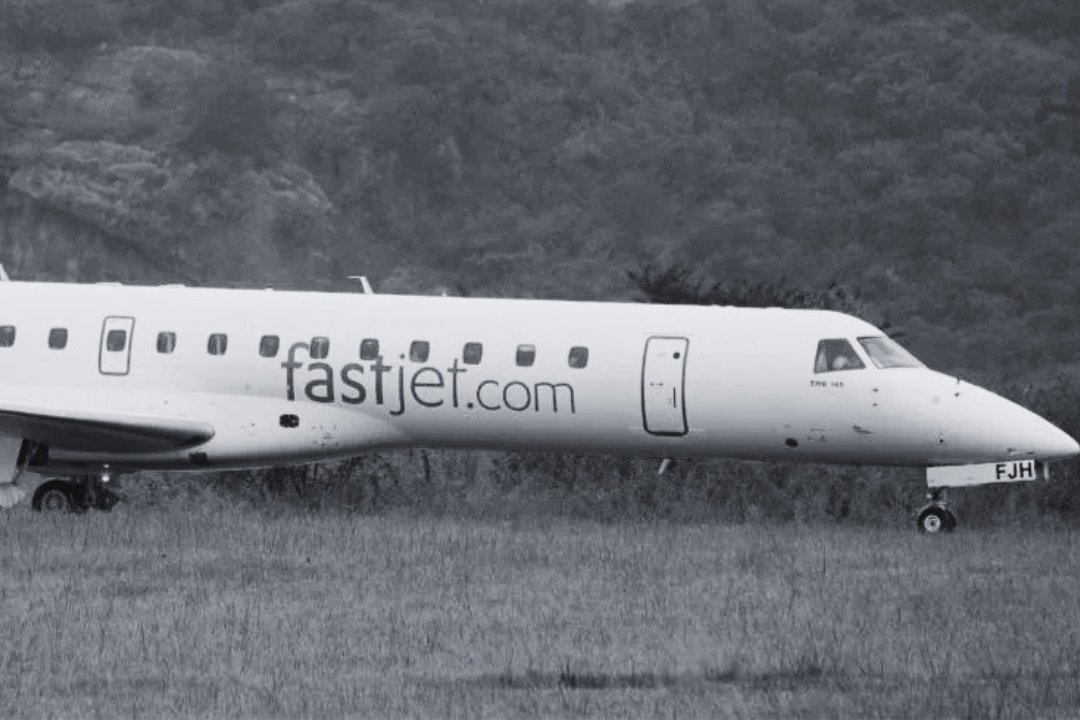
The airline FastJat, operated by Solenta Aviation Mozambique, is on the verge of abandoning its scheduled domestic market operation project. After nearly ten months of waiting and monthly losses exceeding 300,000 dollars, the company finally received, on 17 December 2025, the operating licence issued by the Civil Aviation Institute of Mozambique. But the document contained a clause that had never been requested: the obligation to establish its operational base at Beira Airport, and not in Maputo, where all logistics had been structured. Investors described the licence as a poisoned gift from the Government. This investigation demonstrates that the characterisation is not hyperbole, but rather the foreseeable consequence of a deliberate political choice: to protect the monopoly of Linhas Aéreas de Moçambique at the expense of competition and passengers.
The entire FastJat project was structured to operate from Maputo. The company positioned four Embraer 145 aircraft at Maputo International Airport, hired more than 120 staff, concluded contracts with handling, check-in, catering and fuel suppliers, and invested more than 15 million dollars in the project. Documentation was submitted in April 2025, with all administrative, legal and financial phases completed successfully. The process remained blocked until the approval, on 16 December 2025, of the new Air Transport Licensing Regulation by the Council of Ministers. That regulation introduced an unprecedented rule: competing airlines may not use the same airport as their base. Since LAM operates from Maputo, FastJat was compelled to accept Beira. The president of IACM, Emanuel Chaves, justified the measure as a safeguard against dumping and abuse of market power.
The economic impact of the imposition is devastating. According to figures provided by the company, the construction of hangars in Beira alone exceeds four million dollars, infrastructure that does not exist at the current airport, which was still undergoing renovation works in October 2025. To this expenditure must be added offices, staff housing, vehicles and crew accommodation. All the feasibility studies, financial models and contracts executed and approved by the regulator within the framework of a Maputo-based operation have become invalid. "When we received the licences, we were confronted with a situation that brings tears to one's eyes. What was written there? Operational Base Beira. How does one grant something that was never requested?", questioned a company source consulted by Torre.News. The three aircraft already painted and prepared for operation remain grounded while the shareholders assess whether it is worth investing additional millions in a project whose viability has become uncertain. For now, FastJat will remain solely in the charter flight segment, a model with limited social impact and no influence on the reduction of domestic airfare prices.
The chronology of the blockage is not innocent. The licensing process coincides precisely with the period in which the Government was structuring the injection of 130 million dollars into LAM. In February 2025, the Council of Ministers approved the alienation of 91 percent of the flag carrier's share capital to three profitable state-owned enterprises. Hidroeléctrica de Cahora Bassa invested 36 million dollars for a 25.2 percent stake; the insurer Emose invested 22 million for 15.4 percent; and the Mozambique Railways invested a further 22 million for the same 15.4 percent, as recorded in the 2025 General State Accounts. To this package is added a direct state subsidy to LAM of 255.4 million meticais, according to the Fiscal Risk Report. The entry of a competitive private operator could jeopardise the return on this investment, and this, in the view of several sector sources, is the true reason why FastJat was pushed to Beira.
The financial situation that justifies this rescue operation is itself revealing. In 2023, LAM recorded losses of 3,977 million meticais, with negative equity of 19,670 million meticais. By mid-2024, of the seven aircraft comprising the fleet, only one Boeing 737-700 was operational, a situation that persisted for many months. The Minister of Transport and Logistics himself, João Matlombe, publicly acknowledged in November 2025 that the Mozambican aviation system "is not in the best condition". IACM data confirm this: domestic air transport recorded a 14 percent decline in passenger numbers in 2025, falling from 1,237,566 in 2024 to 1,066,812, with aircraft movements declining by 12 percent.
LAM is also an institution with a documented history of corruption. In February 2026, the Central Anti-Corruption Bureau confirmed the existence of five ongoing criminal proceedings relating to irregularities in aircraft acquisition, unjustified supply contracts, the lease of a Boeing 737 for cargo that never operated due to lack of licensing, payments for non-existent services, and questions regarding the legality of the memorandum signed between Fly Modern Ark and the State Participation Management Institute. Four former directors were detained, including former director-general João Carlos Pó Jorge, accused of harmful management, corruption, misappropriation and abuse of office. In 2020, two former managers had already been sentenced to 14 years in prison for the embezzlement of 50 million meticais. This is the institution that receives 130 million dollars from profitable state-owned enterprises and whose market position the regulator now protects.
The International Monetary Fund's reaction was unequivocal. In its 2025 Article IV Consultation report, published in February 2026, the IMF warned that "the planned investments in LAM by three profitable state-owned enterprises represent risks of diverting resources from critical infrastructure", recommending that "transactions between the Government and state-owned enterprises should flow through the State Budget". The Competition Regulatory Authority, for its part, imposed in August 2025 a fine of approximately 11 million meticais on LAM for abuse of dominant position, on account of the levying of an illegal fuel surcharge that represented on average 60 percent of domestic ticket prices. The existence of this decision confirms that the company systematically uses its monopolistic position for practices that harm consumers. And yet it is FastJat that finds itself prevented from operating.
The social cost of this policy is measurable. Mozambique spans 2,477 kilometres from north to south, with only 19 percent of its road network paved. The World Bank estimates the average cost of extreme weather events on the road network at 160 million dollars per year, equivalent to 1.1 percent of GDP. In 2026 alone, floods destroyed more than five thousand kilometres of road. The rail network connects primarily ports with neighbouring countries and does not link Mozambican cities to one another. In this context, aviation is not a luxury; it is the only real connectivity alternative on the north-south axis. Fewer than five percent of Mozambique's 34 million inhabitants travel by air, according to the IACM president himself, revealing a significant potential market blocked by the absence of competition.
One of the most revealing phenomena of the domestic market's failure is the behaviour of the large multinationals operating in Cabo Delgado. With LAM operating only one functional aircraft during extended periods of 2024 and with a track record of cancellations, delays and technical incidents, companies in the oil and mining sector began using South African airlines to connect Maputo to Pemba. In practice, executives and technicians working on the TotalEnergies natural gas megaproject at Afungi, valued at 20 billion dollars, travel from Maputo to Johannesburg and from there to Pemba, instead of taking a direct domestic connection. The private sector in Cabo Delgado formally warned that the lack of regular air and maritime access excludes local businesses from supply projects to the consortium.
Academic and institutional evidence converges on the impact of this disconnection. A World Bank study on Mozambique concluded that improvements in transport connectivity have a positive and measurable impact on business productivity. The Mozambique Economic Update (2020) explicitly recommended improving transport access in the central and northern provinces, identifying significant disparities in rural connectivity as a determining factor in the decline of access to basic infrastructure. At the continental level, IATA estimates that aviation contributes 75 billion dollars to African GDP, supporting 8.1 million jobs. The Mozambican Government itself acknowledges this centrality: the recently approved Civil Aviation Master Plan (2026-2045) foresees investments of 710 million dollars over two decades. But regulatory policy contradicts that vision in practice.
The imposition of the Beira base also conflicts with Mozambique's international commitments. The country is a signatory to the Single African Air Transport Market and is bound by the Yamoussoukro Decision, instruments that establish the liberalisation of continental airspace and the free designation of airlines. African Union studies estimate that full implementation of SAATM could increase intra-African traffic by 51 percent and reduce airfares by 26 percent. The argument that the Beira clause protects competition does not withstand serious analysis: if the objective were to develop Beira, that mission would fall to LAM, as flag carrier, and not to a private operator that submitted a business plan based in Maputo and whose viability depends on that premise.
The Mozambican State thus finds itself in an impossible equation. On one hand, it injects 130 million dollars from profitable state-owned enterprises to rescue LAM and protects that investment by blocking the entry of private competitors. On the other, domestic passengers decline by 14 percent in a single year, foreign companies avoid LAM on reliability grounds, the IMF warns of resource diversion, the competition authority fines the company for anti-competitive practices, four former directors are detained for corruption, and the only private operator capable of providing relief to consumers is driven towards abandonment.
The growth projected by IACM for the sector from 1.86 million passengers in 2025 to more than 2.9 million in 2027 and 3.1 million in 2028 risks being captured by foreign airlines arriving from outside, while domestic private competence is blocked at its origin. The Confederation of Economic Associations had welcomed the issuance of the licence as a positive step towards market opening, but the Beira clause transformed that opening into a revolving door: the company enters licence in hand and exits with the project rendered unviable.
While the impasse persists, FastJat will remain solely in the charter flight segment, abandoning, at least for now, its ambition to compete in the regular domestic market. Had it commenced operations as planned, Mozambicans would finally have had a choice and prices would have been regulated by the market itself. The absence of competition directly penalises citizens: high prices, limited supply, frequent cancellations and non-existent alternatives. The answer to the fundamental question will determine the future of Mozambique's air connectivity: to continue transferring hundreds of millions of dollars from profitable enterprises to a bankrupt and corruption-ridden airline, or to create conditions for the domestic market to function with genuine competition, competitive prices and operators accountable to passengers rather than to political power.




Comments (0)