

More years than listings: Mozambique's stock exchange turns 27 with only 11 companies
Over 27 years of existence, the Mozambique Stock Exchange has accumulated history, markets, regulations, and ambitious strategic plans. What it has never managed to accumulate is companies. More than a quarter of a century after opening its doors in 1999, the institution created to finance Mozambique's business community and bring citizens closer to the capital markets today counts just 11 listed companies, namely CMH, EMOSE, CDM, ZERO, TOUCH, ARCO, HCB, ARKO, REVIMO, TROPIGALIA and TRASSUS, and has become, in practice, what it never admitted to wanting to be: the counter where the state places its debt. Data from the Bank of Mozambique itself, reported to December 2025, leaves no room for ambiguity. Treasury bonds represent 85.71 percent of everything listed on the exchange and almost all of what is traded on it, 97.99 percent, reducing the equity market, where these eleven companies are listed, to a residual, near-decorative corner. And the institution that should arbitrate this market with independence is itself owned by the state, overseen by the state, and regulated by the state.


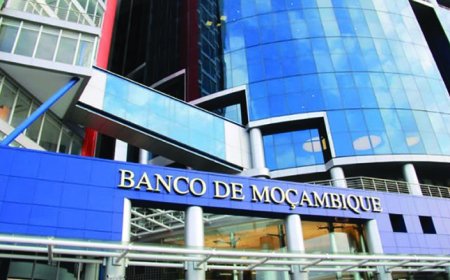
The most accurate portrait of what the BVM has become is found in the central bank's latest Financial Stability Report, covering the 2025 financial year and made public in June 2026. The document puts the market capitalisation of the Securities Market at 221.99 billion meticais, around $3.5 billion, up from the $3.3 billion recorded a year earlier. That growth, however, did not come from companies. It came from debt, driven essentially by the issuance of Treasury bonds worth $664 million, against maturities of $585 million. The Bank of Mozambique concludes, without ambiguity, that the dominance of these instruments on the exchange persistently signals the state financing itself through this market segment.
The scale of the imbalance needs no commentary. If nearly 86 percent of everything listed is sovereign debt, and if nearly 98 percent of everything that changes hands consists precisely of those instruments, then the equity market and corporate bonds together account for a slice barely exceeding two percent of total activity. The regulator itself acknowledges that this configuration reduces the space for corporate financing and does not encourage the broadening of financing alternatives for businesses, which was, it bears recalling, the institution's very reason for existing. The exchange that was meant to diversify the financing of the economy has instead become one of the channels through which the financial system concentrates, ever more, on a single debtor.
The anaemia of the equity segment is old and persistent. In 2019, when it completed two decades, the BVM had around eight listed companies. The leap the institution likes to showcase, from twelve issuers at the start of 2023 to sixteen by the end of that year, was achieved almost entirely by a revealing route: the admission of four companies directly to the Third Market, a segment created not as a showcase for mature businesses but as an ante-chamber designed to prepare candidates for the main markets. It was on this incubation tier that the exchange inflated its count, and it was also there that the fragility of that count was quickly exposed. In 2025, the BVM itself delisted three of those companies, 2BUSINESS, PAYTECH and Mozambique Weiyue International Holding, for failing to meet the segment's regulatory requirements. Between delistings and exits, the number that had reached 16 fell back to the 11 companies that currently appear on the institution's official website. An exchange that celebrates the admission of new companies and months later finds itself forced to expel them for failing to meet the most basic disclosure obligations reveals, in that very act, the distance between announced ambition and reality. Management maintains a target of listing 30 companies by 2028, a figure that would require a pace of admissions with no parallel in the entire history of the institution.
If there is one episode that condenses the hopes and frustrations of this market, it is the Public Share Offering of Hidroeléctrica de Cahora Bassa in 2019, the largest operation ever conducted on the BVM. Close to 687 million shares were placed, at a price of three meticais each, corresponding to the first phase of a 7.5 percent dispersal of the capital of a company majority-owned by the state. The operation, coordinated by Banco Comercial e de Investimentos and Banco BIG Moçambique, had an unprecedented impact on the investor base. Of the 19,210 subscription orders submitted, more than 99 percent came from individual investors, and the universe of exchange investors grew by 191 percent, rising from 7,995 to 22,257, with 18,787 new shareholders in full standing. For the first time, the small Mozambican investor seemed to be entering the capital market en masse.
What followed was considerably less encouraging. The first dividend distributed after the operation, relating to the 2020 financial year, was set at 0.11 meticais per share, meaning that an investor who had subscribed for one thousand shares received 110 meticais, before taxes. The figures rose in subsequent years, to 0.156 meticais in 2022 and 0.27 meticais in 2023, tracking the company's financial solidity, but the share price told a different story. Even after gaining around 38 percent in the first half of 2024, it was trading at 2.73 meticais, still below the three meticais paid at subscription five years earlier.
This economic fragility corresponds to a governance architecture that raises uncomfortable questions in its own right. Since 2023, when it ceased to be a public institute and became a public limited company, the BVM has been wholly owned by the state through the State Shareholding Management Institute, IGEPE. It is overseen by the Ministry of Economy and Finance, which is simultaneously the dominant issuer on the exchange through Treasury bonds. And it is regulated and supervised by the Bank of Mozambique. Within the same orbit, the roles of owner, principal debtor, and regulator are thus concentrated, all of them within the state's perimeter, making it difficult to sustain that market supervision is exercised with genuine distance from the interests of those who finance themselves most heavily through it.
After nearly three decades, the Mozambique Stock Exchange faces a paradox that no institutional communication can dissolve. It has aged as an institution, equipped itself with markets, regulations and strategies, but the market it was meant to serve remains, in essence, unbuilt. It has become an efficient counter for state financing and, in equal measure, has failed as a space for corporate financing and for citizens to participate in the nation's wealth.



Comments (0)