

China and the US want Mozambique's graphite
Two Chinese companies have moved into Mozambique's graphite, the mineral in the anodes of electric car and mobile phone batteries, at Nipepe and Ancuabe, and the American government's development finance institution wants about 20% of Syrah, the owner of Balama. China, which mines almost 80% of the world's graphite, has paused until 27 November the stricter review of graphite it sells to the United States, where Mozambique is one of the largest suppliers.

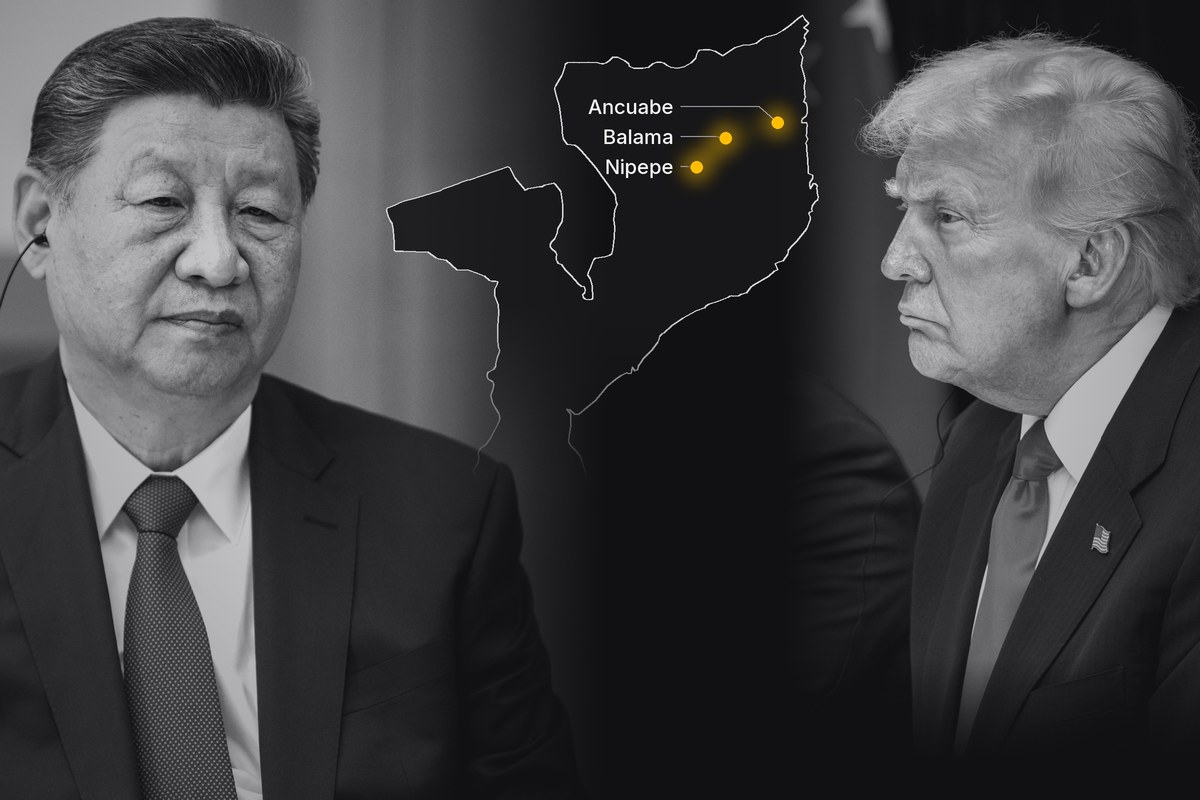
The two Chinese companies came in by different routes. In Nipepe, in Niassa province, President Daniel Chapo opened a graphite processing plant on 30 January, according to the Mozambican state news agency AIM (Agência de Informação de Moçambique). It can process 200,000 tonnes a year, is budgeted at about US$200 million and employs about 1,000 workers, with a target of 2,000. Its owner is the Chinese company DH Mining, according to Reuters. In Cabo Delgado province, a subsidiary of China's Shandong Xinsheng Minerals bought 70% of the graphite assets of Australia's Triton, namely the Ancuabe project and the Cobra Plains concession, AIM reported on 27 August. It paid 17 million Australian dollars, about US$11 million.
The American side runs through Syrah, the owner of Balama, also in Cabo Delgado. The Australian company has supplied Balama graphite to battery anode and industrial customers since 2017. In Vidalia, in the US state of Louisiana, it has a plant that makes anode material from the natural graphite of its own mine, with capacity for 11,250 tonnes a year, according to its website. On 26 March it announced a proposal from the DFC, the American government's development finance institution, in a filing to the Australian stock exchange. The institution would convert US$31 million of its existing loan into shares and take about 20% of Syrah. The proposal is non-binding and depends, among other conditions, on approvals from the Government of Mozambique. On 9 September Syrah said the closing had slipped to the first half of 2027 and that there is no certainty the deal will go ahead, in another filing.
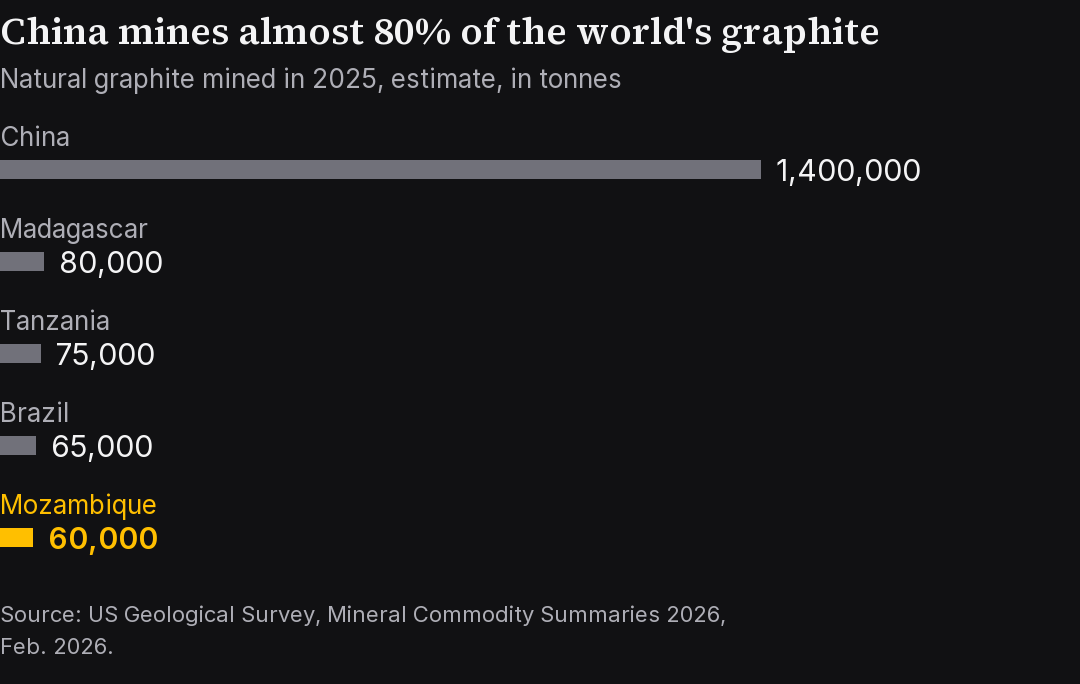
Graphite matters because of the anode, the negative electrode of lithium batteries. China dominates it from mine to refinery. In 2025 it extracted about 1.4 million of the world's 1.8 million tonnes of natural graphite, according to estimates by the United States Geological Survey, and it refines more than 90%, according to the International Energy Agency. If trade in battery-grade graphite were fully disrupted, more than US$300 billion a year of downstream production outside China would be at risk. Hence the value of mines elsewhere.
Mozambique has some of those mines. Its output rose from 39,000 tonnes in 2024 to 60,000 in 2025 and it holds reserves of 25 million tonnes, according to the US Geological Survey. Balama was suspended from late 2024 and restarted in June 2025, and a Chinese company began production at a new mine in Niassa, according to the same source. Mozambique's output and that of Madagascar and Tanzania came to 215,000 tonnes, about 12% of the world total.
China's pauses followed a trade deal with the United States. On 30 October 2025 US President Donald Trump and Chinese President Xi Jinping met in Busan, South Korea. Straight afterwards, the Chinese government announced it would suspend for one year the export controls it had announced on 9 October, according to the Chinese state news agency Xinhua. On 9 November 2025 it also suspended, until 27 November 2026, the stricter review of the graphite it sells to the United States, according to the Chinese state broadcaster. The October controls include those on lithium batteries and artificial graphite anodes, which have never been in force for a single day, according to the Chinese publication Foresight Energy. On 9 November 2026 China's Ministry of Commerce and its customs administration renewed the pause on those controls only until 10 January 2027, according to the text of the notice reproduced by the Chinese platform Mysteel. What comes next depends on the negotiations with Washington, according to Foresight Energy.
China's controls bear on Mozambique indirectly. Mozambique's graphite is natural: it comes out of mines. The anode controls target artificial graphite, which is made in factories from petroleum and coal by-products. If China tightened sales of its graphite, buyers elsewhere would have to look to other mines, such as Mozambique's. In the American market, where Chinese anode material was hit with heavy preliminary duties in 2025, Mozambique supplied 13% of imported natural graphite between 2021 and 2024, as much as Canada and second only to China, according to the US Geological Survey. The National Mining Institute lists anode manufacturing among the ways of processing Nipepe's graphite, according to AIM. TorreNews found no study measuring the effect of the Chinese controls on Mozambique, nor, by 22 November, any decision by Beijing on the 27 November deadline.
The Government wants processing plants and a share of the business. The new Mining Law gives the State sovereignty over strategic minerals, creates a state-owned company to manage them and reserves 15% of mining projects for the State, according to AIM. "No company may exploit strategic minerals in Mozambique without first establishing a partnership," said António Manda, permanent secretary of the Ministry of Mineral Resources and Energy, in remarks the agency published in Portuguese. The partnership is with that state-owned company. The law also bans the export of unprocessed minerals, according to AIM, and the International Energy Agency already lists Mozambique among the countries that restrict trade in graphite. At the Nipepe opening, Chapo said the country is no longer "a supplier of raw materials", according to Reuters.
The timetable for the controls is being set between Beijing and Washington. Mozambique produces graphite and wants to process it, but it takes no part in those talks. The value of Mozambican graphite outside China would depend, in part, on that timetable. The Government's room for manoeuvre would lie in the approvals the American proposal requires and in the new law. TorreNews found no public statement of its position on the sale of Ancuabe or on the DFC's proposed stake in Syrah.
Nothing guarantees China's controls will tighten the market. Two Chinese anode makers, Zhongke Electric and BTR, are building plants in Oman and Indonesia, beyond the reach of Chinese export licences, according to Foresight Energy. The reasons given are delivering close to customers and complying with the European battery regulation.
Two dates are already set. The pause on graphite sold to the United States ends on 27 November, and the pause on the anode controls on 10 January. The first half of 2027, when Syrah expects to close the DFC deal, will show whether Mozambique negotiates the terms for its graphite or has them set for it.

Comments (0)