

Mozambique's gas and mining data contain "serious errors"
The report meant to compare what gas and mining companies pay the Mozambican State with what the State says it received was published without the companies' data, and the committee that oversees it says the Government's figures contain "serious errors". In March, the Extractive Industries Transparency Initiative threatened to suspend Mozambique, as it had done in 2020, and it will assess the country again from January 2027.
The report is published under the Extractive Industries Transparency Initiative (EITI), an international standard that Mozambique joined in 2009 and that requires member countries to disclose what the State earns from oil, gas and mining. A company says it paid the State US$100 million in taxes, the State says it received 90, and an independent administrator looks for the missing 10. This exercise is called reconciliation, and it is what allows citizens to see whether money from mines and gas reaches public coffers.
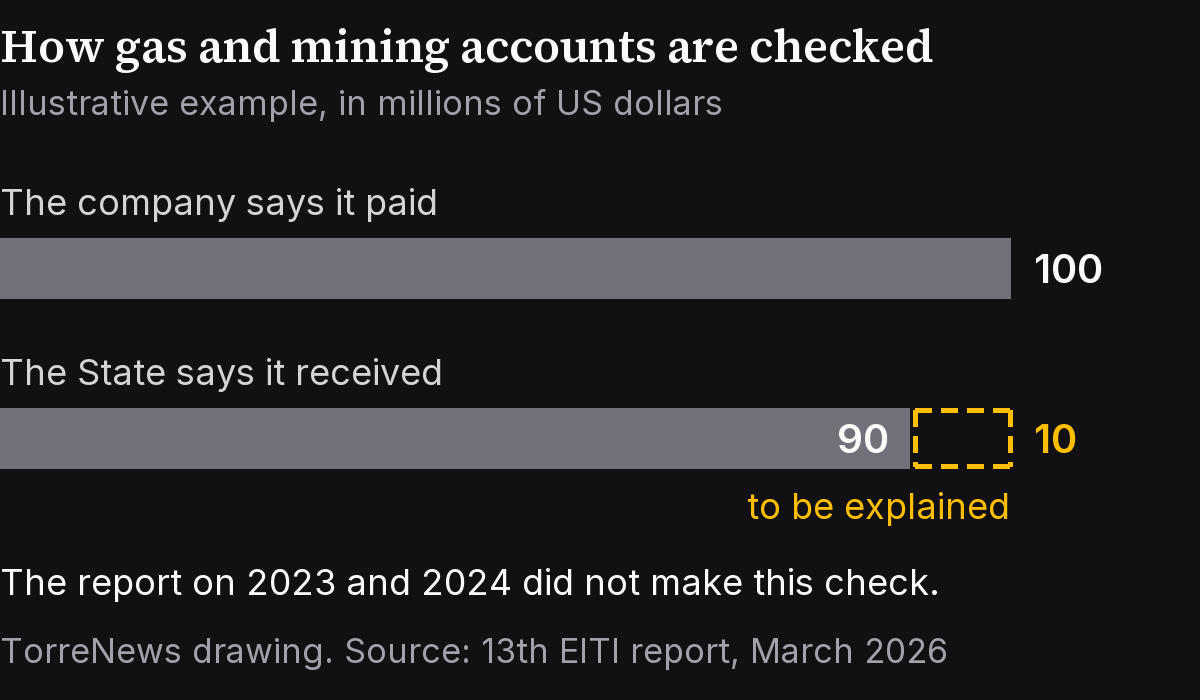
The 13th report, covering 2023 and 2024, came out in March and did not carry out that exercise. No company was selected to report, according to the report, and only State data was included. In the note that opens it, the Coordination Committee, which brings together the Government, companies and civil society, writes that "a informação apresentada pelo governo, apresenta erros graves" (the information presented by the government contains serious errors). The errors were raised by entities that sit on the committee, which does not say what they are or what amounts are involved. It acknowledges that the problem may also affect companies covered by the report that have no seat on the committee. Over the years, the committee writes, differences between the Government's figures and the companies' have come from forms filled in incorrectly by companies, from misclassification by public bodies and from other factors. It asks readers to treat the companies' fiscal information as unfinished data, and adds that much of the information requested from State institutions was not fully answered.
The format was chosen for lack of money and time. In November 2025, a mission from the EITI International Secretariat concluded that, without funds, the country risked missing its deadline and being suspended, and it was the mission that proposed a report based on State data only, the committee writes. The committee accepted it by consensus on 28 November 2025, because it was quicker to produce. On 19 March 2026, the EITI Board gave Mozambique until 30 March to publish. If it failed, the Board wrote in its decision, "the country will be temporarily suspended". Mozambique published and was not suspended.
Mozambique has been suspended once before. On 13 February 2020, the Board suspended it for failing to publish its 2017 report, according to the decision of that date. It lifted the suspension on 16 March 2020, after the 2017-2018 report came out in February.
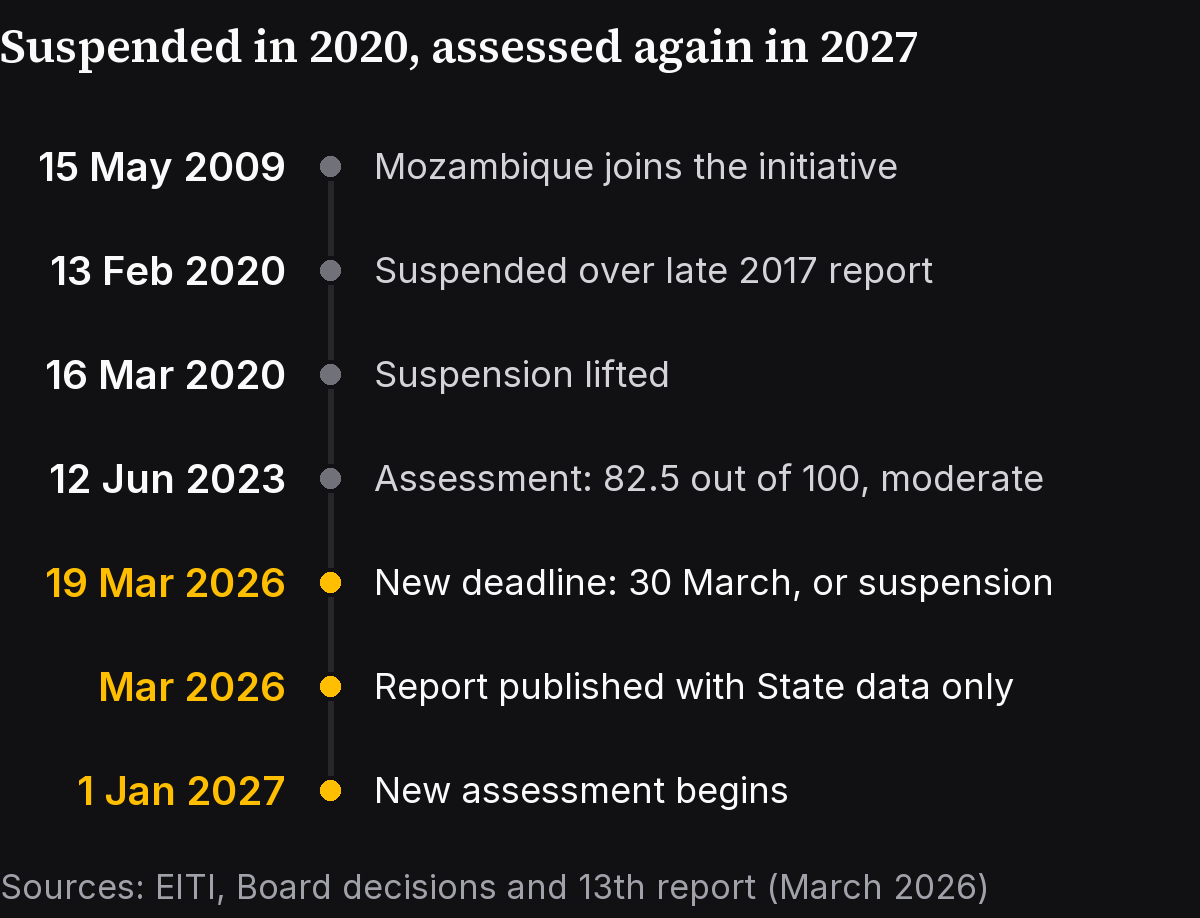
The next assessment starts on 1 January 2027. It is called Validation, it takes place in each country on dates set by the Board, and Mozambique enters it alongside Madagascar, Sierra Leone and the Republic of the Congo, according to the Board's schedule. At the last one, in 2023, the June decision of that year says, the country scored 82.5 out of 100, rated "moderate", one level below "high". On the engagement of the Government, companies and civil society, the score was high, at 86.5. The Board then set ten corrective actions, tasks the country must complete. Two bear on this report: that oil, gas and mining companies participate fully and actively, and that the report assess whether State data is reliable and complete. The same decision says that failure to show progress may lead to temporary suspension.
The EITI's sanction is suspension and, if it lasts, delisting. Under the 2023 Standard, a country rated "poor" or "very poor" on the engagement of the Government, companies or civil society is suspended, and a country suspended for a late report for more than a year is delisted. Today Cameroon, the Central African Republic and Mexico are suspended for inadequate stakeholder engagement, and Guatemala for lack of progress. Madagascar, Tanzania and Ethiopia are under enhanced scrutiny, a form of monitoring the Board can apply before considering suspension, according to the EITI's list of countries. A suspension would deprive Mozambique of public proof that its resource accounts are checked.
Without the companies, the figures for 2023 and 2024 remain unchecked. The committee writes that, without them, the reliability of the data cannot be verified. Audits of the costs that oil companies recover before sharing profits with the State are still under way for those two years, according to the National Petroleum Institute, as cited in the report. And the administrator could not identify the companies' beneficial owners, because access to the Maputo registry had not been granted by the time the report was finalised.
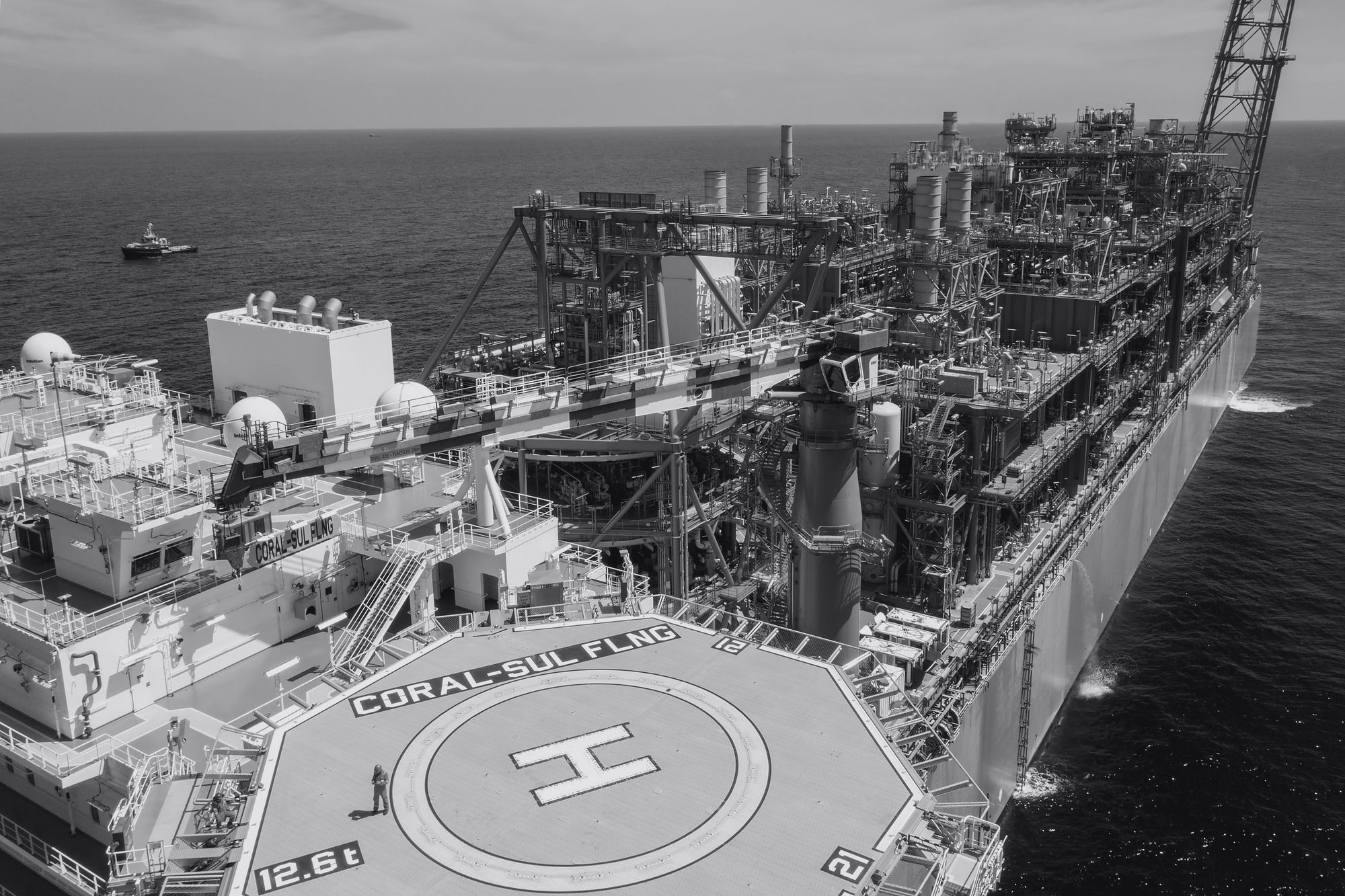
This is the period in which gas started to pay. Area 4, where the Coral Sul floating LNG platform produces, earned the State US$73.4 million in 2023, up from US$0.7 million in 2022, according to Government figures the report reproduces without checking. For 2024, one of the report's two years, the table gives only a projection, US$74.5 million, and projections reach US$90.1 million in 2027. The Mozambique LNG project at Afungi, operated by TotalEnergies, resumed activities in January and expects its first LNG in 2029, according to the company. The more money comes in, the more the missing cross-check matters.
The committee did not hide the errors. The International Secretariat approved the report's terms of reference. The committee also asked companies to give the administrator figures backed by evidence, to correct what can be corrected, and writes that this does not replace reconciliation. Reconciliation is planned for the 14th report, to be carried out by an independent auditor, for which no date has been set.
The January Validation will show whether the Board accepts a report without the companies on the two points it had asked Mozambique to fix.

Comments (0)