

US finds Mozambique worse on budget transparency
The US State Department's annual report says Mozambique does not meet the minimum requirements of fiscal transparency and, unlike the two previous reports, that it made no significant progress. In 2025, according to the report, the government did not publish its budget proposal, and the Administrative Court, which audits the government's accounts and has long depended on it for its own budget, no longer met independence standards.
The report is produced every year on the orders of the US Congress, which tells the State Department to assess whether governments receiving American aid show their accounts to their citizens. It also serves, the report says, to help ensure that US taxpayers' money is used appropriately. The minimum requirements include publishing the budget proposal, the enacted budget and the end-of-year report on time, with reliable information, and having those accounts audited by an independent institution. The 2026 edition covers 2025 and assessed 139 governments and the Palestinian Authority, according to the State Department. Seventy-three meet the requirements. Of the 67 that do not, 14 made significant progress.
Mozambique is among those that neither meet the requirements nor made significant progress, along with Angola, Guinea-Bissau, Zimbabwe, Zambia and Malawi. Cabo Verde, South Africa, Botswana and Namibia meet them. São Tomé and Príncipe does not, but made significant progress. The report says it does not assess corruption, and that a government failing the requirements does not, for that reason alone, have significant corruption.
The two previous reports reached a different verdict. In the 2024 report, covering 2023, and the 2025 report, covering 2024, Mozambique also fell short but had made significant progress, and the State Department wrote that the supreme audit institution, which in Mozambique is the Administrative Court (Tribunal Administrativo), met international standards of independence, according to the 2024 Mozambique page and the 2025 one. The 2024 report added that the court audited the entire executed budget; the 2025 report already noted its limited ability to conduct in-depth audits. In 2026, on the Mozambique page, it writes: "The supreme audit institution did not meet international standards of independence". The report does not say why the verdict changed.
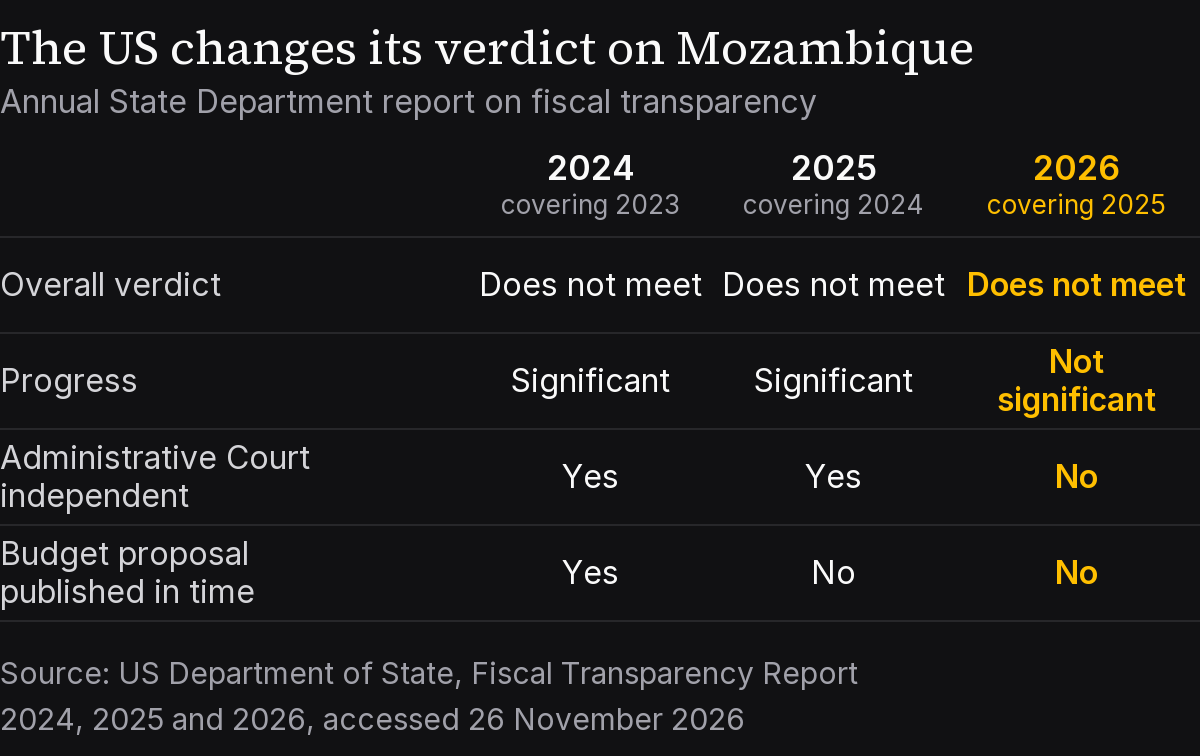
The budget proposal is the document in which the government sets out how much it plans to raise and spend, and it is what allows the budget to be debated before the vote. The 2026 report says that in 2025 the government published the enacted budget and the end-of-year report online, but not the proposal; the 2025 report had already said that in 2024 the proposal was not published in time. Mozambique began 2025 with the 2024 budget rolled over, because the budget cycle coincided with the end of the government's five-year programme, according to the Ministry of Economy and Finance, as cited by Lusa, the Portuguese news agency. The proposal for 2025 was presented to parliament in May, according to AIM, Mozambique's state news agency.
Not everything got worse. Military and intelligence budgets, which the 2024 report asked to be put under oversight, have been subject to parliament since the 2025 report, and budget documents have followed international standards since then. Debt, including that of the main state-owned enterprises, is public, and off-budget accounts have been eliminated. The budget does not break down spending by ministry.
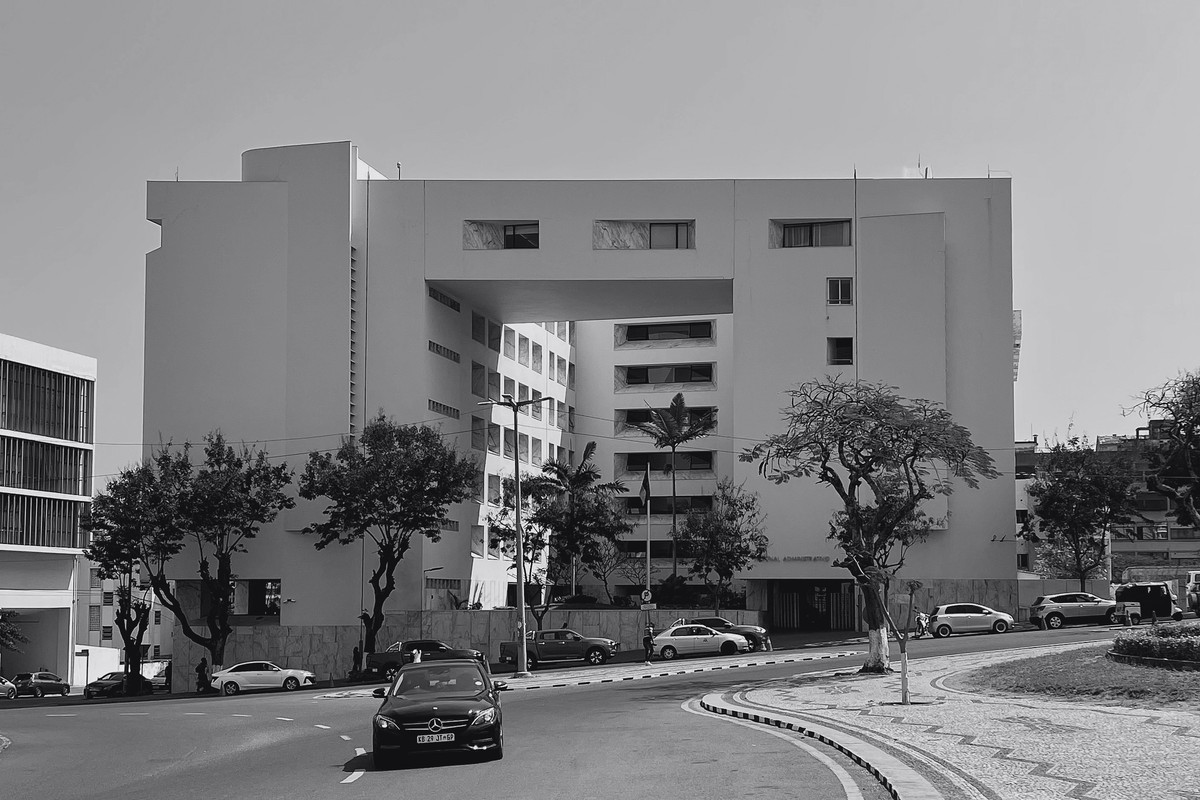
Under the Constitution, the Administrative Court issues a report and opinion on the General State Account, the accounts the government presents after each year, and that opinion is how parliament learns, from outside the government, what happened to the money. The court completed its review of the 2025 account, the year the US report assesses, in early October, according to AIM. On 25 November, parliament debated it. Laurinda Cheia, of the opposition Mozambique Democratic Movement, citing the court's report, said only 34 of 73 planned audits had been carried out, all in the south, and accused the government of obstructing them. Alberto Vaquina, a former prime minister from the ruling Frelimo party, said there were shortcomings but praised the government's efforts to implement the court's recommendations, according to the same agency.
The Administrative Court's budget, like that of the other courts, depends on the government, and the courts want that to end. At the opening of the 2025 judicial year, President Daniel Chapo said he would work towards "a framework of financial autonomy suited to our budgetary reality", according to AIM. On 12 June 2026, at the close of the first Justice Congress, the president of the Supreme Court, the president of the Administrative Court, Ana Maria Gemo Bié, the attorney general, two ministers and the president of the Bar Association signed a pact that describes the judiciary's financial and administrative dependence on the government as a structural challenge, according to the text of the pact. The signatories commit to "guarantee the administrative and financial autonomy of the Judiciary as a whole" and propose writing a fixed share of the budget for the judiciary into the Constitution, to end the annual negotiation with the government. This dependence is not new: in February 2025, when Chapo promised autonomy, the most recent US report still considered the court independent. The same pact proposes turning the Administrative Court into a Supreme Administrative Court and creating a Court of Auditors.
The report does not say the court has stopped scrutinising the government. In its opinion on the 2024 account, the court pointed to discrepancies in the account's statements and reviewed it with reservations, according to Lusa. In the first half of 2026, the court blocked 1.2 billion meticais (about US$17 million) of irregular spending, against 360 million in the same period of 2025, and its Public Accounts Section carried out 55 audits, against 14, according to the court's spokesperson, as cited by AIM.
No aid is cut as a result of the report. The 2012 law restricted US assistance to the central government of any country that failed the requirements, unless the Secretary of State issued a waiver, according to an official notice from 2014. The 2026 law contains no such restriction and sets aside at least US$5 million to help governments and civil society improve transparency, according to the text of the law.
TorreNews found no public response to the report from the government or the court. The next report, covering 2026, is due in 2027. It will show whether the government has resumed publishing its budget proposal and whether the State Department again considers the Administrative Court independent.





Comments (0)